Sunday, 31 January 2010

File existence

This checks to see if a file exists in a directory:

Set objFSO = CreateObject("Scripting.FileSystemObject")
    If objFSO.FileExists("C:\scripts\book.ps2") Then
        Wscript.Echo "file exists!!"
    Else
    Wscript.Echo "File doesn't exist"
End If

So, the first line binds to the FileSystemObject object, then the second passes a value to the FileExists method, and the last bit determines the output.

Tuesday, 10 November 2009

Reincarnation

GPResult

Display information about Group Policy inheritance within the command prompt. A user with admin rights will get info about both user and machine. Variations include getting GP info for another user (gpresult /user [domain\username) or another system (gpresult /s [hostname]).

Use the "super verbose" switch (/Z) and export it to a file (> [UNC]) for a extremely joyous experience.

Wednesday, 5 August 2009

?

If the current Labour administration’s policies regarding immigration can lead to an increase in votes for the BNP, does it follow that their decision to help to overthrow Saddam led to actions of the bombers on 7/7?

Monday, 29 June 2009

The Little Big City

Auckland was raining when I arrived, which is fairly usual at this time of year. It was still warm enough to keep my “jandals” on though. That evening I had enough energy to eat Burger King (now back to its normal name) and fall asleep.

Auckland is a little big city according to tourist posters. It didn’t leave much of an impression on me but I had a chance to meet up with my friend Kim who lives in a suburb there. She and her boyfriend Adam live in a cosy ground-floor flat in what looked to me like a fairly rich area. Kim and Adam were quite interested in my stay in Australia and sounded like they wanted to move there. Neither of them said anything negative about NZ but the impression they gave me was that they were simply waiting for their passports before they could go to the “Lucky Country”.

On my third day there I went to Devonport on the ferry.

100_0895

Maybe because of the weather the harbour didn’t look as striking as Sydney’s. Queen Street, Auckland’s main street, runs down a hill towards the water and the ferry terminal. Next to the terminal is a cargo port, which I liked because I haven’t seen much of that sort of thing before.

When I arrived in Devonport the rain stopped and the sun peeked through the clouds. As the ferry pulled away a rainbow crossed the sky over the port.

100_0900

100_0903

Somebody told me (or I read) that Auckland is like a teenager’s face: eruptions can occur randomly throughout the area. The last one was hundreds of years ago and may have been in Devonport but I forget exactly. There are two there and I went to both, which look no different to any other hill in the world.

100_0918

The British were quick to make military bases out of them.

100_0913

Devonport is very pretty architecturally and has the feel of a village. After my bus ride I had coffee and spent an hour or so looking for books in the two used-book shops on the high street. The first one I went into didn’t have any Greene or Hemingway so I went to the next one and found Travels with Charley and Farewell to Arms. I was getting slightly apprehensive about my up-and-coming sojourn in America and thought it would be enlightening to re-read Steinbeck’s tale.

__________________________________________________________________________

After Taupo and Rotarua I returned to Auckland and spent another night with Kim. During the day before my flight I got stoned and wondered along the beach where I encountered some odd rock formations.

100_1316

The cliff facing the sea was at least fifty foot and was comprised of perfectly formed layers which set me off wondering about the geology of the place. Some of the layers were soft and seemed to be made out of crushed shells.

100_1337

Some of the rocks on the beach looked as if they were were forged by men because of their symmetry.

100_1329

100_1344

Saturday, 23 May 2009

Farewell to Australia

It’s too soon to say now whether I will miss Australia. I got used to the country, just as I got used to living in Britain, and grew comfortable there but I don’t know if I’ll ever have the urge to try and live there again. I may never get the opportunity to live there again, in fact. In that respect, that I’ve only half used my working holiday visa, it is a shame to have left the place.

That I’ve forged a great friendship with Peter and left, that Jess and I parted under such unnecessary circumstances, that I never found a good job and missed the experience of the Australian workplace; these are all potential regrets. Then again, I’ve done Australia my way – bumbled through it, made errors through lack of attention and planning, but ultimately had a very enjoyable time. Who can really ask for more?

I will go back, I’ve promised myself. Next time will be a great road trip spanning thousands of miles through the vast and barren outback and avoiding the beaten track that the backpackers inhabit. Places like the Cape Yorke Peninsula, Arnhem Land and the Simpson Desert will be on my route; places that in the 21st century are still not manicured by man. That’s the Australia I like best.

__________________________________________________________________________

On Monday, a week before my flight, I walked through the Botanic Gardens for the second time. Peter and I missed the bats the first time and this time I was equipped with my Kodak EasyShare ZD710. The city, viewed from gardens and the harbour, is the most impressive urban scene that I saw in Australia.

100_0661 

100_0667

100_0664

100_0656

100_0673

__________________________________________________________________________

I was lucky to have a few people really care that I was leaving – it’s a nice feeling. Probably nothing more than vanity. I was also lucky to spend it in the Rocks – my favourite part of Sydney. Altogether, it was a perfect last week and I was quite glum when I reached Auckland and realised that I really did like Australia and the bloody place was gone.

100_0773

100_0754

100_0770

Tuesday, 19 May 2009

The Original Genocide

A new study in the Journal of Anthropological Sciences by a man named Fernando Rozzi suggests that “Neanderthals met a violent end at our hands and in some cases we ate them”.

Rozzi’s team found a Neanderthal jawbone in amongst human bones with cut marks on it similar to those found on deer and other animal bones which have been stripped of flesh.

“Rozzi believes the jawbone provides crucial evidence that humans attacked Neanderthals, and sometimes killed them, bringing back their bodies to caves to eat or to use their skulls or teeth as trophies,” said the New Zealand Herald.

Lebanese Shame

It’s always sad and often disturbing to learn of the nuances of Palestinian plight, but this was completely unexpected. In yesterday’s SMH:

Of the 4.6 million Palestinian refugees spread across 58 camps in five location – Lebanon, Syria, Jordan, the West Bank and the Gaza Strip – conditions for the 422,000 living in the Lebanese camps are considered the worst.

Palestinians living in Lebanon have no right to citizenship, no right to vote and are explicitly banned from buying private property. To move from one camp to another, Palestinians require a special permit.

Apart from menial labour and some clerical jobs, Palestinians are barred entry to a list of 74 professions including law, medicine, engineering, teaching and journalism.

A Lebanese woman who marries a Palestinian will lose the right to pass on Lebanese citizenship to her children.

Monday, 18 May 2009

NSW Road Trip

Upon my return from the outback, Peter and I ventured northwards in search of thrills. Byron Bay was our target because, apparently, thrills are easy to come by in that part of the world. Peter didn’t seem so keen on Tuesday morning but I persuaded him that it was a clever idea and that he had taken leave so we might as well do something rather than loiter in Sydney for a week.

Although not as empty as some states, NSW is for the most part a place of small towns and emptiness. Empty of humans, that is. The magnificent gum forests that line the roads are probably filled with possums, kangaroos, koalas, emus and all sorts of other Australian fauna. Very considerately, I thought, someone has installed little bridges which hang high above the roads to help the aforementioned fauna to cross the motorways.

The towns are not dainty and picturesque as towns sometimes are in Europe, but rather practical and designed with the motorist in mind. Australia’s beauty comes from nature most of the time, but there is plenty of it to make up for its lack of architectural grandiosity. Peter and I decided, for what it’s worth, that people in these places spend their time fishing, taking their kids to BMX, riding horses, water skiing, playing golf and all the things that people in Gweru used to do. Small town life.

We stopped overnight in Port Macquarie, which used to be a prison within a prison; a place where transported convicts who reoffended were sent. Peter and I had played poker the night before at a pub on Lachlan Street and now we stayed in Port Macquarie – both places named for the early 19th century governor who ended up lending his name to so many places in Australia. Apparently it’s a really nice place in the daytime, but on a Tuesday night it hasn’t got much to offer two young people in search of a few beers. The “hotels”, like many in NSW, are soulless gambling houses with garish decor and walls of television screens showing racing information. A special mention must go to the town’s Irish themed pub whose only Hibernian attribute was a tacky toy leprechaun behind the bar.

We ended up spending most of the evening drinking a few beers back at the hostel where we met a Cornish girl called Churchill who claimed to be related, albeit in a convoluted way, to Winston.

We started the second half of our trip early the next day and punctuated the journey with a stop off in Coffs harbour where we played ten pin bowling. Peter got five strikes in a row in the second game and scored 195. We also stopped, but did not get out of the car, to photograph the big banana.
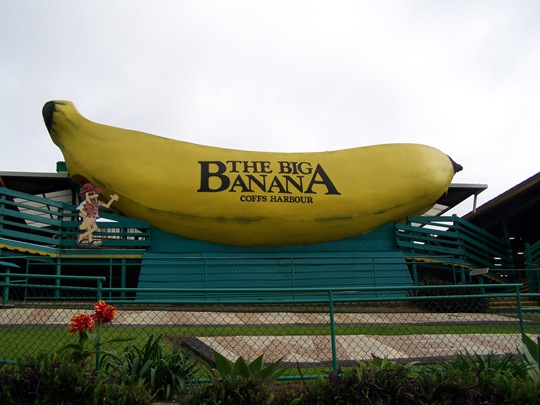
100_0609

(I’d also like to mention that I’ve seen the big pineapple in Qld, too. That was when I was with Nigel around Mt Coolum. That’s four “big things” that I saw in my time in Australia. I still haven’t worked out why exactly the Aussies need or want these things, but there you go: four big things off my list.)

Around this time we decided we were going to spend the night in Nimbin, which is about 50km inland from Byron (although 70km by road). It’s where the coppers turn a blind eye to pot, which was good enough reason for us to want to stay a night there. The GPS took us off the motorways and onto small roads which wound their way through a very civilised looking, hilly countryside where small neat fences and big cows were drawn on the landscape.

Nimbin, which emerged eventually from this anesthetised country, is a good example of why human beings shouldn’t smoke too much dope. Its residents look about 20 years older than they probably are and a lot of them couldn’t really give a shit about giving you that beer or coffee that you just paid for. But dealers line the main thoroughfare and we got what we wanted soon enough.
100_0614

Some people who go to Nimbin for a day stay for a month (if you believe internet forum comments), but Peter and I were content with a day. It’s a bit over-represented here in photos but that’s only because I only took one photo of Byron, and that was with my mobile.

100_0620

The YHA, 15min walk from the village, where we stayed.

100_0632

So Thursday came and it was time for the short drive to Byron. Photographic evidence is thin, as mentioned above, and quite frankly I can’t think of much to say about Byron apart from say that it’s a decadent place, full of backpackers getting drunk and acting foolishly. Nothing wrong with that of course, and I gladly joined in, but not worthy of mention in this esteemed organ. No seriously, Peter and I met up with three English lads in our hostel and got drunk and stoned with them every night and frequented a naughty bar called Cheeky Monkey. We played poker with ticket stubs for chips and Peter even suggested that we all drive to Nimbin again since they had not seen it. It seemed like an odd invitation to me because Peter didn’t really seem to think much of Nimbin the first time round. Sure enough we got there, had a schooner of Coopers, a joint and fucked off back to Byron.

So here it is, my one and only photo of Byron Bay:

DSC00016

On Friday or Saturday Peter and I were cajoled by the hostel staff and the three Englishmen into staying Saturday night for a barbeque (the promise of thirty girls arriving in time for the barbeque by the conniving hostel staff mesmerised Peter, in my opinion). This meant that our drive back on Sunday was a monster.

Back again over the hundreds of NSW creeks and narrow bridges and small towns and the huge rivers and the Dutch village in Coffs Harbour and through the town with the famous pie shop and past the place where the GPS goes crazy and thinks you’re driving in the bush and over the bridge in Brooklyn and home to Marsfield. And the end of a great trip with a good friend.

Friday, 15 May 2009

The Red Centre

I went on a three day tour of Australia’s world famous reddish and arid heartland – how could you not if you in Alice Springs? Well one reason is that it’s 500km from Alice, but if you’ve been in Australia for any decent amount of time you’d know that 500km is not very far at all.

There were about 24 of us from America, Bavaria, Canada, Denmark, England, France, Germany, Italy, Korea, Spain, Switzerland and Sweden and our tour guide was Dave from Qld.  The group was fairly young for the most part and everyone seemed to get along very well. Dave was a really nice guy who told us the earth was 45,000 million years old. His job was to take us to Uluru, the Olga’s and King’s Canyon (1500km over 3 days) and to give us the odd talk on geology and native beliefs.

On the way we drove over a 360 million year old river (the Finke) which is apparently the oldest in the world. The landscape sure looks old. It looks like it’s been battered and burnt and torn apart forever. I remember thinking that about the Zambezi valley but the RC looks even older and more raped. It all used to be under a sea according to Dave, which is why the Olga’s are rounded like pebbles.

100_0396

100_0428

100_0399

The Olga’s are what the honkies called these 36 dome-like structures. The Aborigines called it Kata Tjuta which means “many heads”. Dave asked us to ponder how the Aborigines knew all the heads had only one body, i.e. that all 36 domes were part of one big rock. I figured it was a guess.

When we got back to the bus I caught a glimpse of some outback wildlife.

100_0448

By the end of the trip I came to realise that Outback wildlife (at least the visible wildlife) is all pets that have escaped and come to flourish in the desert, remote from the clutches of man. The camel above is one of over a million and there are hundreds of thousands of brumbies and dingos too.

We missed the sunset at Uluru which struck me as a schoolboy error, given it’s legendry beauty at the close of day. We had to settle for Kata Tjuta, but none of use seemed particularly disappointed.

100_0449

The five o’clock start the next morning was most disagreeable after 2 litres of “goon”. It’s difficult to take sunrise near a big rock seriously when you’re still half pissed from red wine. My photo is illustrative:

100_0454 

With a more light I improved but couldn’t fit the damn thing in the picture.

100_0465

After the photography it was time to either climb the rock or do the 9km walk around it. Seven or eight of us were irreverent enough to ignore Aborigine pleas not to climb Uluru and the rest walked around it. When I was canoeing in Katherine I got talking to a lady from Queensland who told me, “when you go to Ayers Rock do me a favour and climb it, I’m an Australian and it’s my bloody rock too.” Fair dinkum.

It almost fucking killed me in the end.

100_0469

The sign on the right implores you not to climb Uluru but a dotted line shows the best route and metal posts are provided for the steep beginning.

100_0486

Kata Tjuta in the distance above. It’s 36km away from Uluru.

100_0498

Like Ngarkat, the “Red Centre” is awash with flies but they didn’t seem as aggressive as their South Australian cousins. Some people had fly nets but I found that chain smoking is probably as effective.

100_0590

We headed now for our final destination which was Kings Canyon – Dave’s favourite place – but not before we had an another opportunity to take photos of what must be the world’s most photographed rock. (And this time I managed to fit it all in).

100_0506

On the way to the canyon we stopped a few times, once to look at a salt lake and this mountain:

100_0511

Once to look at some brumbies:

100_0516

We also stopped to pick up firewood and to stalk some more camels before getting to our campsite just before sunset.

100_0536

It’s true that King’s Canyon is beautiful and it’s easy to see why it’s Dave’s favourite. But after finishing my 4l goon it was quite wasted on me. We had a great fire all evening and the group got merry and I bruised my leg on the buses tow hitch by stupidly trying to jump over it in the complete darkness. So another 5am start probably wasn’t easy for anybody.

100_0569

100_0571

100_0574

100_0581

This spelled the end of the tour. Now it was just driving and desert and brumbies and camels and more driving and plenty more desert.

Thursday, 14 May 2009

Alice

I was told by a Victorian in Darwin that he had “never seen so many Aborigines in a single place and that I should watch myself in Alice”. It is interesting that he, as an Australian, should express surprise that Aborigines do actually live in significant numbers in some parts of Australia, and, that he feels the need to warn foreigners about them. A German guy called Magnus that I met in Alice said that he was warned in Coober Pedy never to take a lift from a “black fella”.

Australia’s white-dominated culture regards the indigenous man with ambivalence at best and suspicion at worst. Not much appears to have changed since the settler days when the Aborigine caused a nuisance; they are still wholly incompatible with the white Australian endeavour. The Aborigine, however, has been significantly sidelined in this society over the years and now most urban centres are almost completely depleted of the original inhabitants of this country.

Alice Springs has around six or seven times more Aborigines than the national average, which is apparently only 1%. So it is Alice that acted for me as a sort of looking glass into what I have always been told about and never witnessed, and that is the invisible – but all too real – barrier between black and white in this country.

It is Australia’s apparently unsolvable conundrum. It is an irrelevant fact that this problem was created by white peoples’ actions in the past. What matters is what this liberal, tolerant democracy can do about removing a barrier which leads to, amongst other things, a 17 year difference in life expectancy between the ethnicities.

Kevin Rudd said sorry last year which was bound to have warmed the hearts of millions of urban liberals but done little else. Besides, Australia is a small country and has a lot to worry about at the moment. It’s coffers are reeling from the great onslaught of the GFC and, maybe even more scary, Afghans are arriving by the boatload.

__________________________________________________________________________

So anyway, Alice is a small town with a disproportionate number of scruffy Aborigines. I was only there for two nights and a day, which I think is plenty.

100_0315

This is the Todd River which runs (underground maybe) through Alice.

100_0329

The town from a nearby hill.

100_0338

Another picture of the Todd running parallel to a road I never went on. It might be the road to Adelaide.

100_0345

The road to Uluru runs through that gap in the hills. A golf course / oasis is in the foreground.

100_0359

The main street in Alice.

100_0361

…and the famous flying doctors!

Monday, 11 May 2009

The Ghan

100_0257

The Ghan took me from Darwin to Katherine where I went canoeing in a river. Unfortunately it wasn’t in the bit of the river where the “famous” Katherine Gorge is but it was nice none-the-less. Twice I got out of the canoe to walk in the bush and was happy to hear the “thump, thump” of kangaroos darting out of the shade away from me.

100_0281

The oldest farmstead in the Northern Territory, where the canoeing happened.

100_0285

A Boab tree. They’re from Western Australia and look to me like the Baobab’s little cousin.

100_0290

This fella was close to the homestead.

100_0296

I just like this photo.

The Ghan never lived up to my expectations, however. Most of the scenery rushed by during the night and it was pretty impossible to sleep. In hindsight I’m not sure what I was expecting.